Showing posts with label Monuments and Memorials. Show all posts

Thursday, November 11, 2010

Vietnam War Memorial

We (the boy and I) have spent the day on the Mall, and some of the places we perused will show up in other posts, but today is Veteran's Day, and that deserves a post of a certain gravity.  So I overshot completely, and decided to write about the Vietnam Memorial.  On Veteran's Day, it doesn't get much more grave than that, does it.


Normally the Vietnam Veterans Memorial, which is the proper name, looks like this, but if you are eagle-eyed you will have noticed the reflections of lots of people in the wall (live people, unlike the odd photographs etched in stone over at Korea).  Remember, this is Veterans Day, and many of the veterans of Vietnam are still alive.  A subset of the survivors of our longest foreign engagement came to pay their respects and remember their compatriots who didn't make it out of Indochina alive.  You can see some of them below, on the right in the black leathers jackets.

This is our Wall.  In Berlin they have fragments of the Berlin Wall, which was their Wall, dividing one country in two.  In Israel/Palestine there is a Wall which is a political division made manifest in concrete and barbed wire. Here we have our own Wall, memorializing a conflict which divided the United States public just a bitterly as the two halves of Cold War Berlin; even if there was no real geographic division, it was perfectly possible to be firmly on one side or the other of our Wall.  Perhaps that made it even more bitter - your adversaries were not safely locked away on the other side of a wall.  You might work with them, or go to church with them, or live across the street from them.  There was no physical wall, but there was a Wall.

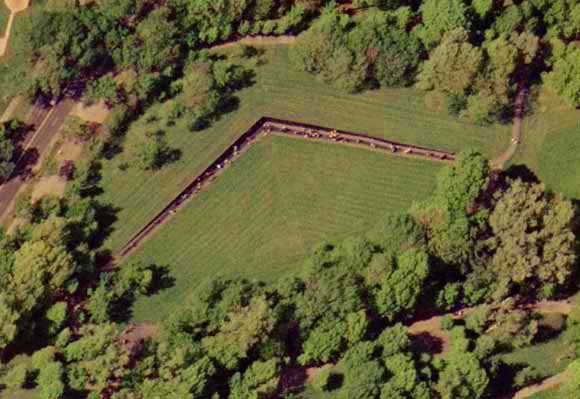
The Vietnam Veterans Memorial from above.  Not my photo (duh).

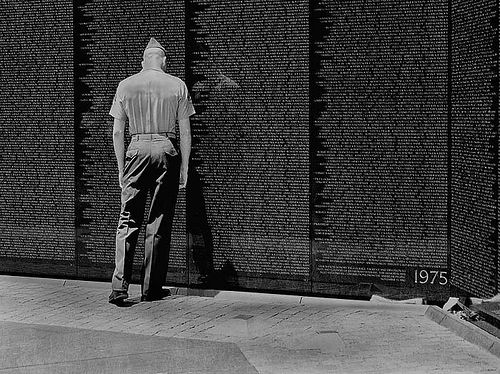
Perhaps it is appropriate, then, that the memorial - wall though it is - has only one side.  It's not really visible in any of my photos, but at either end of the path that runs the length of the memorial the wall is only a few inches high.  As you follow the path towards the center, however, you walk downhill, and more of the wall emerges from the earth, etched with the names of the dead.  At the nadir, where the two downward-sloping paths meet, is this:

(At the bottom of that seam, on the left side, is 1975, the year the last American troops withdrew and Saigon fell, signaling the war's end.  You can see it - the date, not the fall of Saigon - here.)

This is the deepest point of the wall, which feels like a pit, sunlit though it may be, with the wall rising a several feet above your head.  Behind the wall, here and all along it, is earth - the earth from which the memorial rises, cousin to the earth which holds the bodies of the men whose names are carved into the rock (it's gabbro).  But unlike the walls in Berlin and Israel/Palestine, there is no "other side" of this wall.  When you come to see the memorial, you stand on the side with the names.  Everyone stands on the side with the names, and you read them, even if/though you don't know who they are.  We're all on the same side of the wall, united at the memorial to the war which divided us.  We're looking at the names of the men who died in the jungles of Vietnam, and behind them is the earth, from whence we came and where we will return.  Our soldiers have merely preceded us.

Blow up this picture and look at just a tiny fraction of the names carved there. They sound like ordinary men.

Wilbert R. Butler, Lester L. Crooks, Ralph Byrd, Bobby Lee Favors, Guy F. Snyder, Helder A. Correia da Silva, Carl S. Mays, John B. Mecker...

Who were they all?  Each one of those names is more than just a collection of characters etched into a rock.  They were all someone, all people, with families and pasts and aspirations for the future.  They were also all casualties of a war that, when it was over, was hard to clearly define.  What did we get out of it?  Why were we there?  And why did it take so long to leave?

Ring a bell?

Thursday, September 30, 2010

World War II Memorial

Part 5 - the last one - of the adventure which began way down below.  Backdated from almost two weeks later, because I'm a really bad person.  Some things never change.


I may not have liked the Korean War Memorial very much, but I feel quite differently about the World War II Memorial.  Perhaps this is because I have a thing for fountains...
...or perhaps because I appreciate classical imagery...
If you have trouble deciphering this picture (it is a little dark), it's actually eagles in flight holding up a laurel wreath, which signifies victory and heroism.
...or perhaps because I like my monuments dignified.

The World War II Memorial is at the opposite end of the Reflecting Pool from the Lincoln Memorial, and is actually the larger of the two in terms of square footage (just compare the two on satellite view on Google Maps).  The central pool is elliptical (with embellishments) and has a massive fountain at either end with a ring of smaller fountains all around the edge:
Around the pool is a plaza, and on the north and south sides of the plaza are a large portico-type structure dedicated to the two oceans the war forced America to bridge - Atlantic on the north side and Pacific on the south (it's not appropriate to call them theaters, since no one ever refers to the "Atlantic theater" of the war).  Flanking these porticoes are rows of memorial pillars, one for each jurisdiction which contributed troops to the war effort (48 states plus the territories of Alaska and Hawaii, plus the District of Columbia, the Philippines, Puerto Rico, Guam, American Samoa, and the U.S. Virgin Islands).  Each column has a memorial wreath, which is a smaller version of the wreath with the eagles shown above (those are inside the Atlantic and Pacific arches).  Of course, I had to go find Wisconsin; here it is:
Where the Korean War Memorial tries to be too many things, the World War II Memorial is only trying to be two - memorial wall/peristyle and water feature - and I think it works.  The overall simplicity is reminiscent of the more severe federal buildings (think the Federal Reserve building), but little details like the bronze wreaths, the eagles, and the metal ropes you can see on either side of the Wisconsin column base give it a slightly more ornate edge.  I love water features, so the central pool is great, but there are other fountains in the memorial, like the two at the base of the Atlantic and Pacific arches:
I can't really explain it, but for me this monument just works.  Perhaps it's the size, which is appropriate to the largest armed conflict our country has ever been involved in.  Perhaps it's the simplicity which would be starkness were it not for the little embellishments that reminds of the architecture of the Great Depression (like the Federal Reserve building, as I said, which was completed in 1937).  Perhaps it's also that people interact with this memorial - they all go to find their state or jurisdiction and take a picture, then marvel at the fountains (because fountains always get people's attention), and then filter out either towards the Lincoln Memorial if they're going west, or the Washington Monument across the street if they're going east.  Perhaps it's because World War II, unlike Korea, is not a forgotten war, and almost everyone has a family member who fought in it, or knew someone who fought in it, or something like that.  Or maybe it's little things like a small wreath someone brought to set inside the huge memorial - a little token in the midst of the memorial to a very large war that shows us that somewhere, someone is remembering.

(For more about this memorial, click here.)

Wednesday, September 29, 2010

The Reflecting Pool

Part 4 of the adventure which began below.  Backdated from almost two weeks later, because I'm a really bad person.
 
You may have heard bad things about the Reflecting Pool in the past - it's moldy, it smells, it's full of ducks - and I must confess that those are all true, to one degree or another.  But it does reflect!
This is just before the sun came out (in my post on the Lincoln Memorial), hence the turbulent clouds up about the Washington Monument, but as you can see, the Reflecting Pool does in fact reflect.  Of course, when you get closer up, some of the pool's flaws reveal themselves. It does have ducks swimming in it, and the water is hardly filtered fountain quality, but there is another issue which you seldom hear mentioned:

It leaks.
That silvery thing which you see is not a piece of litter - it's actually a rather sad sandbag, attempting to block a considerably larger leak, which has dug channels into the worn dirt path beside the pool (that's another thing - why aren't there paved paths alongside the Reflecting Pool?  Wouldn't that be more aesthetically pleasing?).  As you can doubtless see, the sandbag isn't up to the job, and the pool will just leak as it pleases here and in a couple of other spots that I passed (this is on the south side of the pool - I can't speak for the north, but I imagine it has leaks as well).  Of course, it's not a problem of terribly pressing importance, since it's just a pool leaking water - it's not like the Washington Monument has begun to lean - but it is, as a friend noted, a bit disappointing.  Actually, her comment was "Eww! You have permanently ruined the image in my head with your reality."

Sorry!

Tuesday, September 28, 2010

The Korean War Memorial

Part 3 of my adventure which began on Sunday.  Backdated from a week later because I'm still a bad person.

The Korean War Memorial, 2:00pm

We forget that there was more to the Fifties than Eisenhower, big cars, drive-ins, and sock-hops.  From 1950 to 1953, we were also in a war.  It's a war no one remembers, but it's also a war which is technically still going on today, since North and South Korea never signed an armistice.  A thin strip of demilitarized wasteland runs across the peninsula, separating two countries which, today, are as different as night and day.  At the time of the war, however, they must not have been quite so different.
Unpleasant statistic, isn't it.

It was not a particularly glorious war for the United States and its allies from the UN, and it is not memorialized in a particularly glorious fashion.  The memorial, while it is undoubtedly meaningful for people who were affected by the Korean War, is not stupendous.  For one, I suspect that it could fit inside the Lincoln Memorial with room to spare on either side, but more importantly, it tries to be too many things at once - reflecting pool, statuary garden, memorial wall, and park, all at once.

 
Here you can see all but the pool, which is behind me and to the left.  Also to the left, but further up, is the flag pole (feature #5) and this:
It reads "Our nation honors her sons and daughters who answered the call to defend a country they never knew and a people they never met."

Now, I appreciate the poetic sentiment - "a country they never knew and a people they never met" is a great turn of phrase, sure - but I object to the actual sentiment.  I can understand that these men and women - American soldiers and service-people - didn't know the country and didn't get to know it (in the sense of becoming familiar with it) because they were killed, but are we really to believe that all of the Americans who died in Korea did so with such rapidity that they never met a single Korean?  I think this bothers me because by this logic - or implication, perhaps - the Koreans become faceless and without identity.  They also become passive and non-participatory, which is bogus, since South Korea deployed troops of its own, and surely the Americans encountered them, even if they didn't encounter civilians.  I don't trust M*A*S*H as a historical source, but there are encounters between Koreans and Americans depicted there, and I refuse to believe that were fabricated out of thin air, since the author of the book (which inspired the film and the television series) was in fact a doctor in Korea during the war.

In any case, between the plaques, statues, wall, pool, flag pole, shrubs, and strategically placed trees and benches, the energy of the memorial feels diffused.  The individuals components, taken on their own, are fine.  Some are quite poignant:
These are photographs of some of the Americans who died in Korea, etched into granite.  What makes this picture work for me, though, is the reflections of the living people passing by visible alongside those who have passed on.  This part of the memorial works, and the pool is nice on its own, too.  But the elements are too disparate, the energy too diffused, and it doesn't pull into a cohesive whole.  Perhaps this is appropriate, since the Korean War was a conflict which solved nothing, maintained the status quo, but failed to do more because of catastrophic miscalculation; had UN troops just defended rather than going well beyond South Korea's borders to China (almost), it seems doubtful that the Chinese would have entered the conflict and thrown the UN forces all the way back to the present border and thereby assured that nothing would change on the peninsula.  For a country which still remembered its decisive victories in the Second World War it was probably frustrating.  Appropriately - and perhaps tragically - the memorial is too.

Monday, September 27, 2010

The Lincoln Memorial

Part 2 of the adventure which began below.  Backdated from a week later, because I'm a bad person.

The Lincoln Memorial, 1:20pm


I have come to the Lincoln Memorial, although I have been here once before (briefly, when I was in the city two years ago) not because it lies on my path home - it doesn't, really - but because I like it.  I have great trouble conjuring up any sort of emotional reaction to the Washington Monument, even if it is the world's tallest phallus - I mean, obelisk - but Lincoln is another thing entirely.  Perhaps it is appropriate, then, that as I sit on the steps and write, the sun has come out properly for the first time today.

I also came to see the people.  These are not the swelling amusement-park throngs, and neither are they the emotional mobs who periodically hold rallies here or in the vicinity.  The memorial is a bit out of the way for those going to see the Capitol and the White House, and since it's at the far end of the Mall, it's not something you just stumble across on your way somewhere else.  No, these people are here to see Lincoln.
There is not, to my knowledge, any larger rendering of a human being in this city of larger-than-life figures, but almost as large as Lincoln himself (figuratively speaking) are his words, which flank visitors who enter: the Gettysburg Address, carved in marble on Lincoln's right, and his Second Inaugural Address, ditto on the left.  Some of the people take pictures of Lincoln and then step out to admire the view of the Washington Monument from the other end of the Reflecting Pool, but others step into these two wings which in a religious structure would be chapels and read the words of a man who is as close to a prophet in American mythology as one could possibly be.  But everyone, even the people who come to snap a photo and then leave, is quiet - not silent, of course - but muted, perhaps out of respect, perhaps from awe, or perhaps in deference to Lincoln, for whatever the deficiencies of American popular knowledge, everyone knows who Lincoln is.

No one thinks of the Lincoln Memorial as being particularly ornate, since our common perception is formed by the rather stripped-down versions visible on the back of the penny and the five-dollar bill, but in fact there is some lovely art here.
Even those who don't speak English know him, it turns out.  I have heard languages I can't name on the streets of the District, and this is true at the memorial too.  As I exited I passed several women in saris, some punks with pierced noses, ears, and God knows what else, and numerous others who don't fit the corn-fed, white-bread stereotype.  They were all respectful, if not religiously so.  I suspect that most of us would be when faced with something which, as amorphous as its symbolism may be, is indisputably the representation of something far larger than ourselves.

Enough writing - I need my lunch.  Away from the monument I can find some place to unpack my picnic.  And of course, I can come back here whenever I want.  Appropriately enough, this temple to American idealism is open twenty-four hours a day.
Remember this from high school?