Showing posts with label Church Reviews. Show all posts

Sunday, February 27, 2011

Church Review: Holy Rosary

It has bee a while since I last wrote, I realize, and I have no good excuse aside from general exhaustion, lots of social commitments (people want me at their parties, which is still more than a bit flattering to me), and bad weather malaise.  But the weather shaped up to be gorgeous this weekend so, feeling adventurous, I checked out a new church.  Beware: this one's Italian!

Holy Rosary
595 3rd St. NW
Website  
Holy Rosary is an unassuming church from the outside, located a block from Judiciary Square (or, as they say it on the Metro, Joo-dish-ee-ary) and the National Building Museum, near where 395 plunges into the earth so it can burrow under the Capitol Reflecting Pool between 3rd St. and the Ulysses Grant monument.  It's an easy walk from my place, although I took the Metro up from Chinatown since I didn't have time to walk from home (Mass at noon, I slept late because I was out at a housewarming until two in the morning...you know how it is).  And, although the Metro decided it was fine to take 15 minutes to go three stops, and although I should by rights have been late to Mass since I didn't get there until several minutes past noon, I was still on time.  God bless the Italians and their penchant for starting things late.

Although the exterior is modest and unassuming, the interior - in typical "remember the Renaissance?" Italian style - is gorgeous.  If, of course, you like Neo-Baroque with a hint of Rococo. 
See?  Marble, gold, carved angels, stained glass - the whole nine yards.  While I like the understated Palladianism of St. Peter, anyone who knows me knows that I also have a soft spot for the Baroque (or the Neo-Baroque, which is the closest you'll ever get to the real thing in this country), and this church fits that expectation perfectly.  I am particularly delighted by some of the details:
Mosaic floors...

...vivid stained glass windows...

...and lovely mosaic stations of the cross, for example.  Even more intriguing is that this is a very small church - smallest, I've been in, in fact, perhaps half the length of St. Dominic and certainly not as wide, which makes it feel more exclusive, and allows the art to saturate the space more effectively than the same amount of art in a larger church.  It's like going to Mass in a jewel-box.  

Of course, it being an Italian church with an Italian language Mass at 10 (some day, when I'm feeling courageous...), there is a little Italian priest behind the marble altar, his English slurred and monotone, more likely not because of a stroke, but because his mother tongue is the music of la bella lingua, not flat American English.  A wiry but frail man with a touch of Parkinson's, he totters between the altar and his seat - there is no room for another podium beside the cantor, a burly man who could be a mafia enforcer, and I doubt that he (the priest) could make it up to the top of the raised ambo without considerable assistance - for the prayers, and then informs us that in place of a homily, we will listen to a recorded message from Cardinal Wuerl, since this weekend is the kickoff of the Cardinal's appeal (D.C.'s version of the yearly bishop's appeals which each diocese in the country holds at this time of year to raise money for diocesan programs).  I started tuning the message out when the cardinal mentioned that the money would support, among other things, unspecified "pro-life programs," and resolved that I would give to the various parishes in the archdiocese which need donations to stay open, rather than to the cardinal so he can lobby Congress to restrict access to family planning facilities and end federal aid for Planned Parenthood.  So there.

To soothe my affronted political sensibilities Holy Rosary kindly providing laughing children and an actual organ - the only complaint I have to level against St. Peter, which is approaching the status of home base more than any other church, is its overly-bombastic pianist - with old hymns to match.  It is surprising how many churches have dispensed entirely, it seems, with use of the organ - more than half of those that I have visited, I would say.  In certain ways, I am a traditionalist at heart.

So, how does Holy Rosary score?

Location: 4 - close enough to walk pretty easily, but not exactly in the neighborhood
Aesthetics: 5 - delightful little jewel box with charming details, a great altar, and splendid stained glass
Liturgy: 2 - although it may be better without pre-recorded sermons from the cardinal
Music: 4 - great to hear an organ again, although only for hymns; all the Mass parts were spoken

For a total of: 15 of 20, or 3.75.  I'll come back another week to hear what the liturgy is like without the cardinal "in attendance," although I may come back just to watch the children crawl in the aisles under a golden ceiling and the benevolent gaze of the Regina Sacratissimi Rosarii.

Saturday, January 8, 2011

Church Review: Immaculate Conception

Church of the Immaculate Conception
1315 8th St. NW
Website


The church of the Immaculate Conception (not to be confused with the similarly-named basilica on the campus of Catholic University) is in the Shaw neighborhood, a historically black, middle-class area just north of Washington's official downtown.  The church has its own school, which actually matches the architectural style of the church itself (at least on the outside) - in the photo above the church is on the left and the school on the right (duh - how many schools have steeples?  Answer: two.  My middle school and the high school up the street from it).

Anyway.  I had gone up to Target to get lightbulbs and decided that, since Immaculate Conception is just a block away from one of the stations I passed on my way up to Columbia Heights, I could stop by after I had completed my shopping for the 5:30 Mass.  So I did, and here's my report.

I realize that a week during the Christmas season (remember, the liturgical season of Christmas is longer than the secular one) is not the best time to judge the decoration of a church, but I'll attempt to do so.  The narthex (entry way) is all white with dated (read "80's") glass doors, too much fake foliage, and a picture of the pope above the door.  Bad first impression.  But the sanctuary itself (left) looks almost...German.  I imagine that my brain made this judgment because of the wood paneling in the apse, and all the [fake] evergreen branches wound about.  I have found nothing to indicate that there was a German presence at this parish and am inclined to doubt it, as the Shaw neighborhood is traditionally black, not German, and also because Marian devotion isn't really as big a thing among Germans as other Catholic populations (and in addition to the name of the church and the main altar displaying Mary, not Jesus, there's a Lourdes chapel to the main altar's right.  Lest ye have any doubts about the fervor of the Marian devotions here).

It's not a terribly large church, and the congregation was equally small.  They seemed to know each other, though, and their informal clothing indicated that they felt quite comfortable here.  I imagine this is different on Sundays - this is one of only a handful of churches in the District which has a Mass in Latin (Novus Ordo, in this case - there are even fewer who hold Tridentine Masses).  I soon realized, however, that this was to be an informal Mass - just as well, since I had my shopping with me - because there wasn't any music.  Say what you will about music in the Catholic Church, which ranges from full organ and choir to guitars, drums, and tambourines; a lack of music, however, practically guarantees an informal Mass.  A short one, too - we were out in 35 minutes.

The priest was actually a monsignor, but spoke too quickly to be clearly understood, so I confess that after a bit I switched off and didn't listen terribly closely to the homily.  I looked around the church instead.  Although the light was fading when I arrived, I managed to get a few more pictures:

It's not an unattractive church, although the foyer needs work and the abundance of pine was distracting (4).  The sermon and liturgy were, I'm afraid, totally forgettable (3), as was the non-existent music (2, if we count it).  The location is convenient - just off my line on the Metro, but at night the neighborhood is a bit unwelcoming (4).  I'll have to come back on a Sunday, perhaps for the Novus Ordo Mass, to hear the music and maybe walk around Shaw in the daylight, but as it stands, Immaculate Conception wasn't anything to write home about.  Just a blog post.

In sum: if we discount the music, as there wasn't any, 4+3+4/3= 3.67.  Add the music in and you get 3.25.  Nothing great, but I'm willing to give it another try for the Latin Mass.  To be honest, I've become rather fond of St. Peter, because they have Vespers, and a well-attended Sunday night Mass.  No, there's no organ, and the pianist over-embellishes, but there are young people and families, and the place seems quite friendly.  I just have to avoid the folk Mass on Sunday mornings...

Sunday, December 12, 2010

Church Review: St. Peter

Part 1 of the adventures of Sunday the 12th, backdated from Friday

St. Peter
313 2nd St., SE 
Website

The church on St. Peter on Capitol Hill is quite literally on the hill - it is across the street from one of the annexes of the Library of Congress, which is in turn across from the Capitol itself.  It is also a block and a half from Capitol South Metro, so getting here is no problem at all - I could probably walk it if I wanted to, but I came down to Capitol South after running some errands in Columbia Heights and intended to run more errands before Mass, so I didn't feel up to walking.  Still, this is one of not too many Catholic churches south of the Mall, and the third closest to me (give it a 4).  The other two are St. Dominic, which I've been to numerous times now, and St. Vincent de Paul, which only has one Mass in English, at 8:00am (blurgh); the other, at 10:30, is in Ge'ez, which even I'm not adventurous enough to attend.  What's Ge'ez, you ask?  I didn't know either, until I looked it up.  Turns out it's an ancient Semitic language which was once the official tongue of the Kingdom of Axum and the Imperial Court of Ethiopia; nowadays it's used just about exclusively as the religious language for Ethiopian Orthodox and, in St. Vincent de Paul's case, Ethiopian rite Catholics.  Washington has the nation's largest Ethiopian diaspora, remember, and great food to match; those which are Ethiopian rite Catholic (rather than Roman rite) must go to Mass somewhere.

Howevah, this review is not about a Ge'ez Mass on Sunday morning at St. Vincent de Paul, but an English Mass on Sunday evening at St. Peter.  The church was recommended to me by some friends of K&R (through K&R, since I haven't met these friends, although really I should), who reportedly say that it's quite tolerant.  I was afraid that tolerant meant, as it so often does, hippy and inclined to sloppy modern music, which is why I've put off going for so long (and they do have a folky Mass on Sunday mornings), but it seems silly to look farther and farther afield for new churches to visit when this one is so close.  So I arranged to do some shopping here (more on that in future posts) and then end up at the 5:30 Mass.  I have loved Sunday night Masses ever since I got in the habit of attending the 8:00pm at the cathedral in Freiburg when I studied abroad in Germany, and thought that if I could find something even half as lovely, I'd be set.

The most striking thing about the outside of St. Peter, which I realized as I came upon it after exiting the Metro into a cold rain, is how tall it feels.  There are two reasons for this - the most prominent, of course, is the tower which, as I discovered over the course of the afternoon, can be seen from several blocks away on many sides.  It's also reminiscent in more ways than one of a lighthouse, which is quite fitting for a church, I think.

Second, and less noticeable in a photo than it is in person, is how high up the main church is from the street.  Look at the front steps in the photo up top (sorry about this one - it has the full tower, but also raindrops, apparently).  It's a good five feet vertical difference between the street and where you enter the church.  This has an interesting effect - rather than just stepping into the church from street level, or climbing up a couple of steps, you have to ascend as staircase, a bit like climbing a mountain in terms of symbols.  Other churches have had this (St. Patrick, Sagrado Corazon, and the Cathedral, to name the most prominent), but because St. Peter feels so vertical already, I think the effect is heightened.

Once you step inside and past the swinging wooden doors, you find yourself face to face with something Palladio would find quite pleasant.  I have very few photos because when I entered the priest was saying Vespers (!), and by the time Mass ended I was too hungry to stick around (I was also damp from the afternoon's adventures and wanted nothing more than to go home and eat the pork and potatoes waiting for me in the refrigerator), but I intend to return to take more.  Please forgive my rather poor specimens this time around.

The church does not feel modernized - intentionally, like St. Stephen, or tragically, like St. Dominic - but neither does it feel so old, like St. Mary Mother of God, that the very walls resent the use of the vernacular.  It's very much like St. Patrick, but less grandiose (recall the size of the apse there vs. the size of the apse here).  The coloring, as you can see, is very tastefully done - cream walls with tan accents, lots of light, and a bit of colored marble and gold, but sparingly used.  There are rounded arches everywhere, but the setting off of those arches with clean straight lines (look up at the top of the apse, and the lines that run backward to the choir loft) given a feeling of airiness and clearness that I thought was refreshing.  I felt like the modernist folds of St. Stephen were trapping - this, on the other hand, felt fresh and open.  Ah, Palladio (who?) - and Brunelleschi too, come to think of it (see).

The rear of the church is also quite nice - the choir loft is one of the prettiest I've seen in this country.  Feels like it ought to be in London somewhere.


Aesthetics, a 5.  I seem to be handing those out quite a bit lately.

The liturgy itself would qualify for run of the mill.  It was a forgettable sermon, and nothing particularly interesting in the rite except that the servers -both girls, which is great - wore the old surplices, though without any patterns, rather than the typical white albs.  But I probably would have thought things pretty average had I not come in early and stumbled upon the second half of Vespers.  There was the priest, standing with the cantor, chanting Vespers, in an elaborate gold cope.   I thought - mistakenly, it would appear - that American Catholics had given up on Vespers and left it to the rich Episcopalians who could afford to hire an organist on weekday afternoons.  Turns out St. Peter has made do without the organist, and substituted in a talented pianist (!) instead.  During the Mass he did some modern but classical-feeling settings of "Oh Come Oh Come Emmanuel," and I was pleased to see that the hymnal had some older hymns in it.  4s for both Liturgy (since I'm feeling generous, and since this was the best attended Sunday evening Mass I've ever seen in this country, complete with quite a few young adults) and Music.

This means that St. Peter averages 4.25 (4+5+4+4=17/4=4.25), pretty good.  I'd be interested in attending another of the Masses, though I'd be willing to make a Sunday evening Mass my tradition, just as I did in Germany.  And, you know, I have to go back so I can get some better pictures!

Sunday, November 7, 2010

Church Review: The Cathedral of St. Matthew the Apostle

Part 1 of an adventure begun today, backdated from Monday.

The Cathedral of St. Matthew the Apostle
1725 Rhode Island Ave., NW
Website
I have finally made it to the Cathedral, thanks to the federal government, which gave me (and you, if you're one of my readers living in the United States) an extra hour of sleep this morning.  Normally, I don't want to sacrifice my precious sleeping-time to trek all the way up here, but with an extra hour under my belt, I felt energetic enough to do it.  And am I glad I did!

To get here I took the Green line up to Chinatown and then transferred to the Red, since the Blue and Orange lines are on crack (read "being maintained") this weekend.  I got very lucky with both trains - a three minute wait at Waterfront and four minutes at Chinatown.  Interestingly enough, today I decided not to worry about making the trains; I just went.  Perhaps this means I should stop worrying about trains altogether?  Still, had the trains not cooperated I would have missed Mass; 4 on location for the days when Metro is feeling benevolent, and 3 on those days it isn't.

After a short walk up Connecticut Avenue and a right turn on Rhode Island (which, interestingly enough, is something one could actually do in Connecticut - make a right turn at Rhode Island), the first thing I saw was the hulking pile of red brick pictured above.  The only real clue that it's a church and not a fancifully-done gymnasium is the dome, and the single ornamentation on the facade - this mosaic (visible in the lower right of the picture above).  Upon arriving in front of the church the primary impression is one of tallness, not of beauty.  In fact, I remembering musing that it looked more like a church with its skin taken off - or unfinished - than what one would expect a cathedral to look like.  There is precedent for churches with unfinished facades - it happened a lot in Italy, where city-states or wealthy families would bite off more than they could chew and be unable to finish their cathedral/church (an example: this picture of San Lorenzo, the Medici family church in Florence, whose facade has never been completed).  But this doesn't usually happen in the United States - if a church project runs low on funds, you strip back the design rather than continue on the originally planned path until the money runs out.  This generally means lopping off towers...which was also the case in Strasbourg back in the Middle Ages.  The mosaic, however, is a hint: whatever the plainness of the cathedral's exterior may tell you, ignore it - when people starting dealing in mosaics, it means they aren't messing around.

See?

Inside the architects have made up for their outer frugality several times over.  Every single surface is decorated in some way, be it with marble, mosaic, glass, fine metalwork, painting (fresco?), carpet (yes, alas), or sculpture.  It is so much to take in that I scarcely know where to start.  Fortunately for you, I took lots of pictures, so I'll let them do most of the talking.

The Cathedral is actually relatively small - it is no longer than the Cathedral in Green Bay, where I once was an acolyte (but it is wider).  Like most cathedrals, it is cruciform (shaped like a cross - a Latin cross in this case), with the two transepts forming the shorter bar of the cross and the nave the longer bar.  This is the left transept:

Opposite it, in the right transept, is the organ (about which more will be said later):
(If you find the ceiling decorations reminding you of something, well done - it's mimicking the ceiling in St. Peter's Basilica in Rome.)

Where the transepts cross the nave (the technical word is "crossing" - not joking) is indisputably the best place to put a dome...

...and so the celebrant has something pretty to look at while he says Mass, the back of the church is also decorated sumptuously:
(Do you see that crimson blob on the left, in between the two hanging lanterns?  It's a cardinal's hat - the old-style one, called a galero - which I presume has been strung up from the cathedral ceiling in celebration of Archbishop Wuerl's impending reception of his own, about which I have already expressed my feelings.)

I have lots more picture but, at risk of extending this post to an absurd length, I'll save them for a rainy day.  Suffice it to say that this place is absolutely gorgeous, and fully deserves a 5 for Aesthetics.

You will doubtless have noted the presence of an organ, in the right transept (not in the choir loft, where it ought to be, but this is most likely because there isn't a choir loft, so I suppose I'll forgive the powers that be their less-than-ideal placement of the organ).  What this means, however, is that the sound is projected across the transepts, not down the nave to the altar, so if you're not in the transepts or the crossing, the sound is muddy and unclear (it's probably pretty bad on the altar, too - sometimes even if the sound is good in the rest of the church it's bad near the altar).  The organist seemed moderately skilled, although he left the cantor (who didn't enunciate enough) and the congregation (which was timid) behind on a few occasions.  I was beginning to contemplate awarding a 3 for music, but then the organist had the last laugh: the postlude was Aaron Copland's "Fanfare for the Common Man," which sounds surprisingly good on an organ.  Well played, sir - have a 4.

The most unique part of this experience, of course, was the liturgy, since this was a Latin Mass (the sermon was safe and forgettable).  Not a Tridentine (pre-Vatican II) Mass, mind, but the Latin language version (technically the original, rather than a version) of the Mass, commonly referred to as the Novus Ordo (New Order, but you knew that).  Very kindly, the Cathedral provided handbooks for the Ordo Missae (Order of the Mass, which you also knew, surely) alongside the hymnals, for which I was grateful, since I don't know the Novus Ordo anywhere near the level I would need to to sing it unaided.

That's right, sing it.  The Missa Novus Ordo is primarily sung, both by the celebrant and the congregation, so the youngest of the three (!) celebrants, who cannot have been older than 30, got to do the singing bit (you can hear the pope do it whenever Masses are broadcast from the Vatican - Christmas Eve Mass, for example, is usually carried on EWTN live, so when it's midnight in Rome you can sit down after dinner in the Midwest and listen to the pope's quavering voice sing the celebrant's parts of the Missa Novus Ordo - add that to your calendar).  It is chant, much of it centuries old, and written in Gregorian notation (see the picture).  I have only passing familiarity with Gregorian notation, since the only place it's used any longer is churches where Masses are sung in Latin, which are not commonplace in the Midwest (this sort of thing gets more play on the East Coast, where the Catholics are generally more conservative than those in the Midwest).  Of course, I'm also not used to singing some of the longer prayers in Latin (Agnus Dei is one thing, and it's only three lines, but the Confiteor takes up two and a half pages!).  It's entirely possible to get distracted by the unfamiliar text and mess up the chant, or focus on the chant so intently that you end up neglecting the text, producing beautifully-chanted schwas.  There is no denying that chanting the Mass in Latin feels more mystic and formal, but it's disjointing if you aren't used to it.  3 because I keep tripping up - 4 once I've learned it.

Summary
Location: 3 / 4 (3.5)
Aesthetics: 5
Music: 4
Liturgy: 3 / 4 (3.5)
16/20 (4)

A good rating, an average of 4 (though, depending on other factors, it could slip to 3.75 or rise to 4.25), bit there are signs here of some of the less pleasant aspects of the Church's doings.  For example, the homilist (the eldest of the three celebrants) felt compelled to mention, although it was by no means integral to his homily, that when God created marriage (ahem), he created it between a man and a woman (I have plenty of counterarguments to both points of this statement, but I'll refrain from haranguing and merely note that I disagree), which is quite in line with Cardinal-designate Wuerl's stance on the matter.  Furthermore, at the end of the Mass the baby-faced celebrant introduced the middle-aged celebrant as a deacon from San Antonio, who was there with students from his school.  An Anglican school, because (as Babyface explained), Cardinal-designate Wuerl is the pope's liaison with those American Anglicans who wish to come more fully into communion with the church.  In other words, not only is the not-yet-cardinal one of Washington's biggest homophobes, but he's also His Holiness's hatchet-man vis a vis the Anglican community.  I don't even know the guy and I detest him.

What I'm trying to say in a roundabout and highly sarcastic way is that although I liked Mass at the Cathedral - liked, not loved - I'm not exactly comfortable with one of the celebrants who may turn up (I'm glad I didn't end up going to the Red Mass, as I read later that it was something of a pro-life tirade, which is why Justice Ginsburg no longer attends the Red Mass).  While I may return to familiarize myself with the Latin and hear the choir, which was off this week, I'm pretty sure - no, certain - that St. Matthew the Apostle is not my religious home.

Sunday, October 31, 2010

Church Review: St. Mary, Mother of God

The evening after the rally I thought I might spend out on the town, but I soon realized that the downtown was still a madhouse (even though the rally ended at 3), that I was far too tired, and that it was cold - fall has finally arrived, more than a month after it arrives in the North, but it gets cold at night now!  Nevertheless, I walked up to Chinatown with K & R because they had to deliver a coat to a visiting mutual of ours who had left it at their apartment.  I figured I might as well go to church while I was out and then sleep late the next morning (this morning), but I wasn't sure when we would get to Chinatown from our base in Waterfront, since the Mall was such a madhouse.  So I made a sort of wager with myself - if we made it by 5:00, I would go to Mass at a new church, St. Mary Mother of God.  If we didn't make it, I would go to the 5:30 at St. Patrick.

If you have two brain cells to rub together, you've probably figured out (from the title of this post) that we made it up in time for the 5:00 Mass.  Ergo, another church review:

St. Mary, Mother of God
727 5th St. NW
Website 

St. Mary, Mother of God, is nestled in a nook carved out of the Government Accountability Office (GAO), which takes up the rest of the city block (not kidding - check it on the map).  It is a relatively short walk - a trifle shorter than it takes to get to St. Patrick, since it's just as far north but not as far west.  I don't have a good time estimate since I started out from K & R's and had to dodge rallygoers (and the Burning Man Dragon), but I suspect that on a normal day, coming from my apartment, I could walk to St. Mary in about 35-40 minutes.  A 4 for location.

It is an unassuming church from the outside, rather standard-issue Gothic revival, although the stone is luscious.  Its most prominent feature is its tower:
Imagine for a moment that you're in England.  This tower would fit quite nicely (at least in the England I carry around in my mind - I don't know about yours).  But even so, nice as this tower is, it doesn't hint much about what's inside.  Perhaps similar gothic-revival architecture - lots of bare stone, pointed arches, and so on?

Well, inside is a church which escaped the renovations of the post-Vatican II era (which so unhappily emasculated St. Dominic) almost entirely unscathed.  From the moment I entered the vestibule and saw the worn swinging wooden doors, painted which with wavering glass in the windows, I knew something was going to be different.  And it is - St. Mary, Mother of God appears not only to have escaped Vatican II, but time itself.

If you were to remove the [rather unobstrusive] sound system, ignore the vent in the wall for the HVAC, and turned off the electric lights, this might well be the original church (I don't know about the padded kneelers, though).  The floor is tile, but the pews stand on a wooden platform a few inches above aisle-level, much like the old churches I've seen in historically-preserved places like Colonial Williamsburg.  The wood of the platforms is smooth, polished by the shoes of long-dead parishioners.
The windows are tall and narrow, and their subtle patterns make them feel delicate, almost as though they were made out of paper, or spun sugar.  Spindly yellow marbles columns rise up to support the vaulted ceiling, painted heavily in blue (the color traditionally associated with the Virgin Mary) and maroon, the panels broken up by creamy plasterwork that reminds me more of cake icing than anything else, or by golden medallions, and festooned with patterns and wispy golden tracery.
On either side of the altar, which would be perfectly comfortable in a pre-Vatican II church, marble angels gaze adoringly upwards towards the stained glass windows in the apse which proclaim "Sancta Maria, Mater Dei."  Beneath Mary's feet is the altar itself, golden door of the tabernacle shimmering, flanked by golden candlesticks and the flags of the United States and the Vatican.  To call it a feast for the eyes is insufficient, but will have to do.  An uncontested 5 for Aesthetics.

Nothing distracts you from all this beauty, because the church is silent.  Although located on the edge of Chinatown, outside noises barely penetrate, and the sparse attendance of this Mass (Saturday, before dinner) generated little noise inside.  So much silence can be a bit intimidating (especially when one is foreign to a particular church and feels a bit like an interloper), but I expected the somewhat disconcerting silence to be broken soon enough by an organ prelude or something, but nothing came.  The 5:00 Mass is supposed to have a cantor, but none ever presented him- or herself.  In fact, this Mass had no music whatsoever!  I can hardly give a 0/5 for Music if there wasn't any, so I'll just have to leave it out of the score.  Intriguingly, I noticed that I felt much less engaged simply speaking the Mass parts rather than singing them.  Perhaps music is more than simply a nice bonus...

The priest was a plump elder man of East Asian descent (most likely Chinese, since this is the church that does a Cantonese Mass every week, and I'd be willing to bet, going from his accent, that this is the priest who says it).  He had broken his knee a few days earlier and so moved very little, but it seems to have affected his preaching as well, for between his languidness, his accent, and a few fits of temper on the part of the sound system, I understood only portions of what he said, and have forgotten it entirely.  3 for Liturgy, since I'm willing to give him the benefit of the doubt.

Summary
Location:  4
Aesthetics: 5
Music: -
Liturgy: 3
12/15 (4) or 12/20 (3)

If we remove the Music category entirely, St. Mary, Mother of God gets a 4; with Music in (and scored 0), a 3.  Obviously, I'll have to return at some later date to do further research, take more pictures, and see (hear) what the music's like.  But aesthetically, this is one for the record books.

Sunday, October 24, 2010

Return to St. Stephen & a Haircut from the Mafia

Part 1 of an adventure begun on October 24th, backdated from a week later

DuPont Circle, 1:00pm

I'm sitting on a bench in DuPont Circle - in it; the actual circle is a park - where I've just finished my lunch. Now, while I let my food settle, I'll take some time to write, people-watch, and report on this month's adventure so far.

I had intended, as I often do, to go to the 10am Latin Mass at the Cathedral this morning, but as has always been the case, decided that I didn't want to get up at 8:00am to catch the [annoyingly infrequent] Metro up. One of these days I'll actually do it - perhaps not after a night spent up late doing, of all things, chores. [Incidentally, I just found out yesterday that the archbishop of Washington, Donald Wuerl (pronounced "whirl") - remember him? The one who ended the archdiocese's adoption programs because DC legalized same-sex marriage? - has just been awarded a cardinal's hat. I'm not making excuses for this one.]

In any case, I went back to St. Stephen Martyr, because it's close to a branch of the salon where I got my hair cut last month and I needed another trim (I promise it's not as trippy as the website would suggest). St. Stephen, it turns out, has barely changed: the same languid cantor, the same hymns - I swear, if I hear "Eat This Bread" used at communion one more time I'm going to break something - different priest but same sort of forgettable sermon; in fact, I've forgotten it already. It may be the best plainsong in town (although I'll bet I can find better), but I don't intend to make this a regular thing.

After Mass I went to find the salon and discovered it closed, much to my disappointment (I understand that stylists need a day of rest too, but could it please not be one of the two days when all the rest of us actually have time to get our hair cut?), so I wandered up 19th St., resolving myself to no haircut and intending to skip ahead to the next step - the eating of lunch. But as I walked along, through a neighborhood of glitzy office towers with little lunch places on the first floor - all closed since it's Sunday - I kept my eyes peeled (ew) for a stylist. Then I spotted one, nestled in between a restaurant and a row house, with a bar in the basement. It was in one of those tall brick row houses that used to dominate the area, a bit crumbly around the edges. I climbed the stairs to the first floor (basements here are not real basements, they are English, which means fake or only half-submerged, depending on your dialect) and peered inside to case the joint and all of a sudden it was 1920. See?
Not my picture - I stole it from their website, although the Christmas decorations were not in place, for obvious reasons.  (Warning - this sit has music on it, so once you get there scroll down and turn it off if ambient website music bothers you as much as it bother me.
The salon, called Daniel's, has high ceilings and hardwood floors and high ceilings, dark wood walls with mirrors and old-style lamps hanging down and emitting golden light. After determining that a haircut here would set me back no farther than what I had originally intended to spend, I was handed over to an old Italian gentleman who assessed my hair ("eet ees verra straight, your hair") and gave me a good, clean haircut using a real razor, and wanted to know if I going to watch "da game" (Redskins vs. Bears; probably not). All around me I heard more Italian accents and wondered if perhaps I had stepped into mafia front, in the best way possible. "You go to school here?" my stylist asked. No, I told him, I came here for work. "You'll like da city," he assured me genially and clipped away. His next appointment, a boy in his mid- to late teens, came in and they greeted each other. "Where's your father?" the stylist asked, running a razor up the back of my neck. "Parking the car," the boy replied. "OK," the old man answered. "Go upstairs and get your hair washed." It felt like I had stumbled into the neighborhood barbershop from a mafia movie.

Of course, it wasn't, and this wasn't even close to the Italian church (Holy Rosary, on the other side of Chinatown, which I intend to attend at some point - maybe even one of the Italian-language masses), and when the stylist gave me his card, I discovered his name was Simon. I was kind of hoping it would be Beppe.

********
UPDATE (November 8th): In the course of my November 7th, I stumbled across Daniel's again, and got a picture of the outside - in a crumbling rowhouse, like I promised:
Daniel's is the one with all the green awnings.  A hole in the wall, really - but a cozy, Italian hole in the wall!

Saturday, October 16, 2010

Church Review: Return to Sagrado Corazón

As I mentioned in last week's church review, I intended to visit Sagrado Corazón again to see if they used the organ at the 4:00 Saturday Mass, and I am disappointed to announce that they don't.  I suppose I shouldn't be surprised, since this Mass was quite possibly the most sparsely-attended religious service I've ever witnessed - even worse than Europe.  Of course, there are probably a couple of reasons for this: there are only two English-language Masses here, which suggests that there isn't much demand for English, and it's 4:00 on Saturday afternoon - prime time for the doing of other things.  Hell, the only reason I'm here now, besides my curiosity, is the fact that I intend to spend tomorrow morning packing for my business trip to Indianapolis.  So I went to Mass, with about 40 other people (I kid you not) and listened to quasi-modern music on piano.  But at least I got some photographs out of it - forgive the grainy quality of some of them, as I neglected to bring my camera and had to make do with my phone instead.

Just about every Catholic church has something dedicated to the Blessed Virgin, but certain traditions revere her more than others.  The Hispanic tradition is one of those which hold Mary highest - think of Our Lady of Guadeloupe, for example.  At Sagrado Corazón, the Virgin gets her own chaplet to the right of the altar (the left if you're standing on the altar, but I wasn't).  If you ignore that light in the background (through the arch is the brightly-lit main altar), you might be at some soaring church in Europe, or even back in the Byzantine Empire, if the Orthodox did statues (they generally don't).

This photo actually came from my trip last week, but I didn't want that post to be overly-long, so I didn't post all my shots.  But look at the details, and all the different colors:

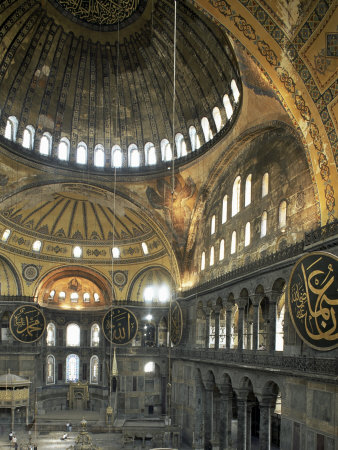
One of the things that intrigues me most about how this church looks is the quasi-Islamic decorative style.  I've never been inside a mosque, but I've come across plenty of pictures of them in the course of my various studies (Art History, Cultural Studies, and so on).  Because ultra-orthodox Islam forbids the portrayal of the human image, many mosques and palaces (think the Alhambra) are decorated primarily with geometric patterns.  The round arch is a common feature of Islamic architecture too.  I hadn't thought about it before, but inside this church feels both Islamic (above) and Byzantine (below).
Doesn't this dome make you think of the Hagia Sophia?
Pretty cool, huh?

One more, this one from my phone as well:
Those lights to very interesting things to pictures taken by phone.  I'm not sure I dislike it - it's just an interesting addition to the photo.  For art and architecture I will definitely come back to Sagrado Corazón; good sermons too (if last week wasn't an anomaly).  I'll have to keep looking elsewhere for music, but nothing's perfect.  And besides, I wouldn't want to declare my church-hunting adventures over just yet!

Sunday, October 10, 2010

Church Review: Sacred Heart/Sagrado Corazón

Sacred Heart/Sagrado Corazón
3211 Sacred Heart Way NW
Website 
A friend of mine suggested that I join him for an afternoon in Columbia Heights, and while I declined to join him at his Unitarian worship service that morning, I was all for seeing a new part of town, so before we met for lunch (magnificent pizza, with clams on it!) I went to fulfill my own religious obligations.  New neighborhood, new church, and this one's a doozy.

Columbia Heights is a neighborhood on the edge of gentrification, so there's a fusion of young professionals, gays, and students with people of African, Latin-American, and East Asian descent.  Sacred Heart is the neighborhood's only Catholic church, and it reflects this diversity.  How do I know this after only one Mass, you ask?  Easy: there are nine Masses at Sacred Heart each weekend.  Saturday at 4 is in English and at 6, in Spanish.  Then on Sunday there are four Spanish Masses, one in English (the 10:00, when I went), and two more in the evening, one in Vietnamese (!) and one in Haitian (!).  This alone is a far cry from the churches I have visited since I moved here, but you will soon see more reasons to put this particular church in a category of its own.

Location: To get to Sagrado Corazón, as I will call it from here on out, given that it has more Spanish-language Masses in a single day than most churches have in any and all languages in an entire weekend, I simply hopped onto the Green line half a block from home and rode it north to the station in Columbia Heights.  Then I walked two blocks, first past the gentrified banks and department stores, then - after turning a corner - past taquerias, little grocery stores, and the sort of grungy little shops you see in National Geographic or world news pictures from the wire.  Soon the austere majesty of Sagrado Corazón's dome reared up from behind the narrow apartment buildings; give it a 4 for Location.

Aesthetics: Inside, Sagrado Corazón reminds me more of than anything else of London's Westminster Cathedral (that's the Catholic one - the Abbey is Church of England.  Go Google it for some pictures).  The basis for both churches is a spartan stone (or, in S.C.'s case, maybe concrete?) space topped with a large dome, neo-Byzantine with a hint of Romanesque.  But while Westminster Cathedral's most impressive feature is its cavernous interior (unless you count the gaudy facade - go on, Google it), Sagrado Corazón is a Hispanic church, and it shows.  Gloriously.


There's tile and fresco (or something like it), statues, candles, hanging lamps; colors, metals, stone, wood, concrete, marble, tile, glass, and light.  Visually it is a riot of different stimuli, which is something I like - in a religious building especially, I think of it as a fitting metaphor for the complexity of the world around us.  I found, before the Mass started, that I could easily linger over small details in the decoration, and if I had had time I would have savored every little bit - but I had a lunch to get to and suffice it to say that on Aesthetics, a 5 is well-deserved.

Music: I was disheartened to see modern hymnals in the pews and a piano in the front of the church, but the music was from immediately post-Vatican II, rather than the sloppy 80s and 90s feel-good mush.  The dozen-person choir did a very good job, given their material, and although the music was modern, I hadn't heard some of the pieces before.  There is an organ in the choir loft, and I intend to go the Saturday English Mass to see if they use it, but altogether, pretty good for modern music.  I'll be charitable: 4.

Liturgy: But the real distinguishing characteristic was definitely the sermon.  What a change from last week!  Remember that St. Patrick is an old church in the downtown with a very traditional style.  Sagrado Corazón is a young[er] church in a diverse neighborhood with a much more diverse congregation and a distinctly more modern style.  Furthermore, the church is staffed by Capuchins, a sub-group of the Franciscans, who are second only to the Jesuits in their tolerance and open-mindedness, at least among the major orders. And today's readings were about lepers, which are a fantastic device for anybody writing a sermon, because they can be used as a metaphor for practically anything (well, I exaggerate, but not much).  The little Salvadoran concelebrant who gave the sermon did exactly that.  Who, he asked, are the lepers, the people that our society ignores?  We allow ourselves, he said, the be divided by race, class, gender, sexual orientation (!) and so on, but the people who get no attention in the public sphere whatsoever are the victims of domestic abuse.  Good start.  Next: the church must recognize, he said, that it has sinned by enabling domestic violence to continue because it has counseled women to forgive and forget and to preserve marriages at all costs, even if they must endure abuse.  The church, he added, has not spoken out against domestic violence at all.  Of the two-hundred-twenty some diocese in this country, only a handful have domestic abuse programs, and nothing has been said the the US Council of Catholic Bishops.  1 in 4 women will be victims of domestic abuse at some point in their lives.  You can bet that if that were 1 in 4 men, he said, the hierarchy would be up in arms!  But women are the victims, and the church says nothing.  We as Church, he said, have sinned against our sisters who suffer at the hands of their husbands, we have sinned against the victims of domestic violence who are the lepers of our society.

He stepped down from the podium and the church erupted in applause.  I applauded too - a 5, without a doubt.

Review
Location: 4
Aesthetics: 5
Music: 4
Liturgy: 5
18/20 (4.5)

In sum, I like this place quite a bit.  If I can just find a Mass - preferably in English, since my Spanish is a bit weak - where they use the organ, I will have found my DC version of my old church in Hyde Park, Chicago, St. Thomas the Apostle.  I'll keep sampling churches in any case, because it's fun (yeah, I'm weird), but this one is definitely a keeper

Sunday, October 3, 2010

Church Review: St. Patrick

St. Patrick
619 10th St. NW
Website 
The church of St. Patrick is the oldest Catholic parish in the District of Columbia - it was founded in 1794, just five years after the very first Catholic diocese in the country (Baltimore, 1789).   The current building is not that old, of course, but it is the prettiest church I've seen so far.  Although I am fighting my inner raven ("ooh, shiny!"), I believe this is the church the late Senator Ted Kennedy attended when he was in the city - understandable, since both are Irish - which only adds to the "ooh, shiny!" factor.

Location: Located between DC's tiny Chinatown and the Downtown, and a block from the National Portrait Gallery (a 4 for Location, since I can to it in about 35-40 minutes, a pleasant stroll up 4th St., across the Mall in front of the Capitol, and then up Pennsylvania Ave., which would be even shorter if I took the Metro), St. Patrick is unassuming at first.  But step inside and you see this:
Aesthetics: The church is bathed in golden light, with marble and stained glass flashing color.  It's also full of statues - the last time I was in a church with this many statues I think I was in Europe.  The whole picture exudes a feeling of opulence, richness - which is perhaps fitting for the oldest parish in the city, and also the closest church to the White House (though not to the Capitol - there's another that's closer).  This church is not holding back in terms of art - in this photo of the apse you can see stained glass, painting (those narrow arches under the windows are saints, painted on golden backgrounds), marble (the altar and lectern) and wood (the pews).  In addition, there are bronze stations of the cross, marble statues (both below), candles, and tiles.  A 5 on Aesthetics for sure.
The statue in the foreground is, of course, St. Patrick, the church's namesake.
Music: I had expected to be disappointed, as I usually am (alas), by the music, but was encouraged upon entering the church to see no piano or guitarist standing in the front of the church, and encouraged further when I entered my pew to see that the hymnal was hardcover and red (basically, when I see a paperback in a church pew it's battle stations) .  And then, wonder of wonders, someone started playing the organ.  Remember the organ?  The only instrument we used to write church music for for the longest time, until somebody decided that the organ was just too hard to learn and to play (and perhaps to grandiose for our "enlightened" times) and a piano would do just as well instead?  Well, St. Patrick has an organ - a pretty good one - and somebody who knows how to play it.  Unfortunately, the acoustics are a bit muddy, perhaps because a sound system was installed for the priest and the cantor to use, and it may have upset the delicately-calibrated balance of the space.  It was a rather sparsely attended Mass, so there wasn't a whole lot of singing going on either, but on the whole the musical situation is above average here.  4.

Liturgy: Of course, there has to be a skunk at the picnic (life wouldn't be any fun without a skunks at picnics), and this particular skunk wore vestments.  Now, I understand, sir, that this might be your second or even third Mass of the day, but that gives you no excuse to roll your eyes and rush through the Mass parts like you've got some other place to be.  Nor does it give you any reason to toss the host down so you can genuflect and get on with that pesky consecration.  And then - heaven forfend - you have to give communion to the congregation - ach, the peasantry!  I won't keep going because you can see what I'm getting at.  Because he was actually capable of preaching (although I don't remember what he said, because I was too busy keeping myself from walking up to the lectern and punching him in the face), I won't let him drag the rating all the way to a 1, but a 2 is nothing to be proud of.

Review
Location: 4
Aesthetics: 5
Music: 4
Liturgy: 2
15/20 (3.75)

In sum, I have found a pretty good church that's tolerably close to my apartment and has good music.  Today it also had a douchebag presiding, but I intend to give it another chance (the 10 am Mass has a choir!) because aside from the priest, it's a lovely place, and very conveniently located for post-church shopping.  Because it's close enough to walk, I'll surely be back - and if I'm lucky, the skunk at the picnic won't.

Sunday, September 26, 2010

Church Review: St. Stephen Martyr

This week's posts are part of a new endeavor - several segments of my writings throughout my adventure today.  Each post is the spur-of-the-moment piece I wrote at the location and time noted at the beginning of the post, plus some editing and rearranging.  I've decided to try this (dividing up one day's adventures into a couple of posts) because I noticed that last week's posts were vacuous and rather uninteresting - but let's face it, very little happens at work that a) is interesting and b) I can tell you about.  So we're going to try something new - let me know in the comments if you like it! 

St. Stephen Martyr
2346 Pennsylvania Ave. NW
Website

Foggy Bottom, 12:30pm

As I write I'm sitting on the campus of [the] George Washington University, passing for a student at the country's most expensive undergraduate institution - or so I was told by the GWUers I studied abroad with.  I'm inclined to believe it.
Ivory Tower?  Guys, you know that's usually meant as an insult, right?
I've just come here from the 11:00 Mass at the church of St. Stephen Martyr, a Mass unlike any I've ever experienced.  Some of my readers may know that I had originally intended to go to the cathedral (St. Matthew the Apostle) today, but after a night spent playing Battlestar Galactica: The Board Game and drinking into the wee hours of the morning (I was President Laura Roslin, which shouldn't come as any surprise to anyone), I was in no condition to haul myself all the way up there in time for a 10:00 Mass.  11:00, on the other hand, I could handle, even though Foggy Bottom is about as far away from me as the cathedral is.  I was willing to make the trek, though, because the Mass was billed as "Solemn Chant," and I had to find out what that meant.

It took me some time to find the church, since Foggy Bottom isn't a part of town I'm familiar with.  I was actually a couple of minutes late and missed the processional, but I wasn't the only one, and found a seat with ease.  Then, singing responses as I went - Solemn Chant Mass, it turns out, means everything is sung - I looked around.  "Chant" may make you think that I was in an old church, but in fact the opposite was true - see?
The church is not terribly big - I was almost in the back when I took this - but it is definitely interesting nonetheless.  If you read my review of St. Dominic and don't know me very well, you might have begun to wonder if I wasn't one of those arch-conservatives who wants to scrap Vatican II and go back to the Middle Ages.  Similarly, you might have concluded that I like my churches old - the older the better - and my music equally so.  I will admit to a preference for old church music (and other kinds of music - I love medieval and Baroque), but I don't want to trash Vatican II, and I have been known to appreciate modern art and architecture as well - I do live in a Brutalist apartment complex, after all.

What is perhaps most intriguing about St. Stephen Martyr is that its modernity, with a sleek '60s feel like some of Southwest, manages to feel old at the same time.  Perhaps this is because it is not cavernous like some large, modern churches - it feels cozy, actually, nestled up to a building on one side, with a relatively low ceiling (as far as churches go, anyway).  The size and the whitewashed walls allow you to imagine that instead of being in downtown Washington, you're in a church carved out of living rock in the highlands of Cappadocia, like this one

Perhaps it's also the glass.  Compare these: on the left, a window from St. Stephen, with the right, a window from Chartres Cathedral.  They both have the same blue background - in fact, this blue color predominates at Chartres, and is so famous that it's called "Chartres blue."  Even more interesting (I just noticed this now) is that both depict a spear-bearer.  How odd.


Another comparison: the back window of St. Stephen (this is the large arch you can see from the street) and the rose window at Reims.  (I knew there was a reason I like St. Stephen's glasswork so much!)
St. Stephen (forgive the blur - I don't like obviously taking pictures in a church which isn't otherwise a tourist spot)
Rose window at Reims Cathedral
In any case, add to this stained glass a gold-vested priest, enough incense to kill an asthmatic, and a mix of medieval and modern-retro liturgical music (as in after Mass parts were written in English but before they got sappy), and I was awash in a very different experience.  I'm not sure what to make of it, really, but as I do in a church review, I'll set down some thoughts.

Location: 3.  I could walk this, if I have an hour to burn, because it's not so much far north as it is far west (I'll put it on the map soon).  I can take the metro, but it runs infrequently on Sundays - in fact, I blame the metro for making me late more than anything else.  It's doable, but far from ideal.

Aesthetics: While not a treasure-trove, St. Stephen Martyr is an unexpected find, and much prettier that it could have been.  As you can see from the tangent above, I find it intriguing, visually, although I won't be swooning from visual overload any time soon.  4.

Liturgy: I like incense, so billowing clouds of it aren't a problem for me, though I would advise asthmatics to sit in back.  As in, the last pew.  It makes me wonder, though - do they have smoke detectors in churches?
Liturgy was mostly sung, which is good because this parishes actually sings (some don't, although having good acoustics, which this church does, helps a lot).  The priest, on the other hand, needs some coaching - on multiple occasions he would begin a passage and it would take me a few moments to realize that he was actually singing it - I mean, that rather uncomfortable tone issuing from his mouth (word to describe it fail me) could have been his formal reading voice, right?  In preaching, however, he's doing fine.  Not lofty and inaccessible like the Dominicans, but quite open, friendly, easy to grasp.  I'm not sure his logic is as sound as it could be, but points for an accessible style.  His sermon gets a 3, but throw in that incense and some chanting and I'll give it a 4.

Music: Good - better than St. Dominic in terms of content, but about the same in terms of execution.  The cantor, alas, had the tendency which many female cantors do, to sing slower than the organ when being accompanied and draw out her notes; it is a way of getting noticed, because the cantor who does such a thing likes the sound of her own voice (she was also vested, which bothers me for completely different reasons which don't need to be examined here).  They have a small choir organ in back to serve them while they raise money for a proper one, and although it is small, it did an admirable job.  The choir (four people total) is good, though they need to work on their blending, and the cantor is full of herself.  Well, no one's perfect.  4.

Review
Location: 3
Aesthetics: 4
Liturgy: 4
Music: 4
15/20 (3.75)

Seems about right - it's nicer than St. Dominic in most ways, but its location is a real kicker.  I'm not going to truck all the way up to Foggy Bottom on a weekly basis for a mere three-quarters of a point, but it's a good place to keep in mind for that intriguing melange of old and new - or if I feel like I need some incense.